Introduction to Mediation, Moderation, and Conditional
Process Analysis: A Regression-Based Approach
Third Edition
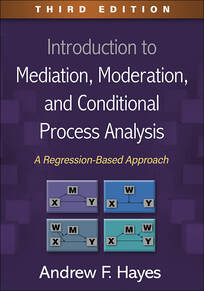
Introduction to Mediation, Moderation, and Conditional Process Analysis describes the foundation of mediation and moderation analysis as well as their analytical integration in the form of "conditional process analysis", with a focus on PROCESS for SPSS SAS, and R (#processmacro) as the tool for implementing the methods discussed. Available as both an e-book and in print form, it is published by The Guilford Press.
Here are the data files and code used in this third edition of the book.
Here is the errata for the third edition.
If you are looking for the files used in the second edition published in 2018, click here. The first edition of this book is now out of print, and much of the PROCESS-related content in the first edition is out of date and will not work in the latest release of PROCESS. Here is an errata document for the first edition, and here is one for the second edition.
Here are the data files and code used in this third edition of the book.
Here is the errata for the third edition.
If you are looking for the files used in the second edition published in 2018, click here. The first edition of this book is now out of print, and much of the PROCESS-related content in the first edition is out of date and will not work in the latest release of PROCESS. Here is an errata document for the first edition, and here is one for the second edition.
Go to processmacro.org to download PROCESS for SPSS, SAS, and R and its associated files.
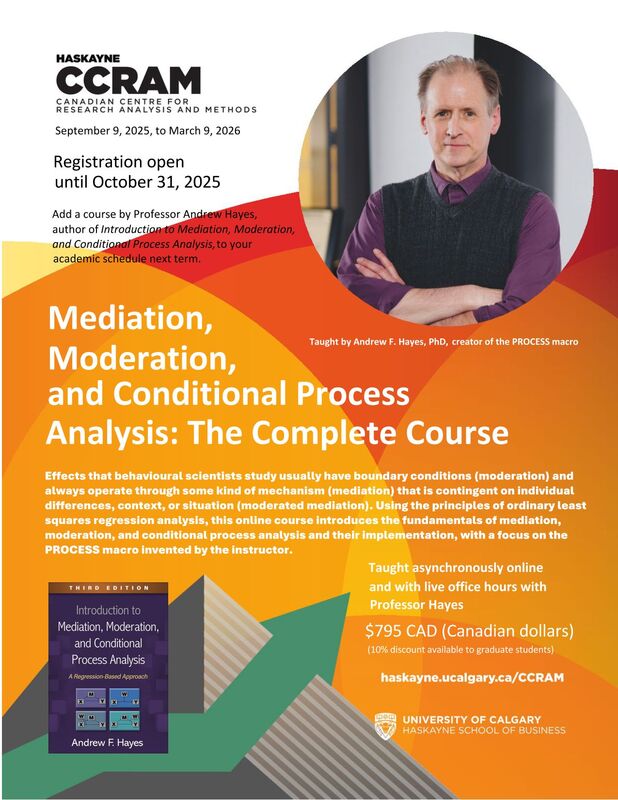
Take an online class from me on the topic of this book. Class officially starts September 9, 2025, and runs through March 9, 2026, but you enroll as late as October 31, 2025. There are no set times when you must be online. Click here for more information.
What's new in the 3rd edition?
The third edition is a bit longer than the second edition by about 30 pages. The sequence of chapters in the third edition is consistent with the second edition, and the vast majority of material in the second edition has been retained. Yet most pages are a bit different, most significantly the result of adding syntax support for R users and the release of PROCESS for R. Other changes include the addition of new sections dispersed throughout the book. Below is a nonexhaustive list of the some of changes in this edition relative to the second edition:
• New code for R users accompanying every example, including PROCESS for R released in 2020.
• A substantially rewritten Appendix A to reflect new features added to PROCESS since the second edition, including a discussion of similarities and differences in the syntax structure in PROCESS for R compared to PROCESS for SPSS and SAS
• A more detailed discussion of effect scaling and the difference between unstandardized, completely standardized, and partially standardized effects in Chapters 3 and 4 and the implementation of standardized regression coefficients in PROCESS.
• A new discussion in Chapter 5 about a method for comparing the strength of two specific indirect effects that are different in sign
• An expanded discussion and illustration in Chapter 5 of the partial correlation between mediators in a multiple mediator model and the generation of this correlation using a new PROCESS option.
• The introduction in Chapters 11 and 12 of a bootstrap-based Johnson-Neyman-like approach for probing moderation of mediation in a conditional process model, with R code for generating a visual depiction of regions of significance.
• A discussion in Chapter 14 about testing for interaction between a causal antecedent variable X and a mediator M in a mediation analysis and how to test this assumption in a new feature available in PROCESS.
• A section on power analysis and sample size section originally in Chapter 4 has been expanded and relocated to Chapter 14.
New to SPSS syntax? Do you want to teach or emphasize the use of SPSS syntax in your classroom? Download my free "Using SPSS: A Little Syntax Guide" from the Resource Hub at the Canadian Centre for Research Analysis and Methods.
If you like Introduction to Mediation, Moderation, and Conditional Process, try my regression analysis book: Regression Analysis and Linear Models
Some of my related work that might interest you:

Hayes, A. F., Allison, P. D., & Alexander, S. (in press). Errors-in-variables regression as a viable approach to mediation analysis with random error-tainted measurements. Behavior Research Methods [PDF]

Coutts, J. J., & Hayes, A. F. (2023). Questions of value, questions of magnitude: An exploration and application of methods for comparing indirect effects in multiple mediator models. Behavior Research Methods, 55, 3772-3785. [PDF]

Igartua, J.-J., & Hayes, A. F. (2021). Mediation, moderation, and conditional process analysis: Concepts, computations, and some common confusions. Spanish Journal of Psychology, 24, e49 [PDF]

Hayes, A. F., & Rockwood, N. J. (2020). Conditional process analysis: Concepts, computation, and advances in modeling of the contingencies of mechanisms. American Behavioral Scientist, 64, 19-54. [PDF]

Coutts, J. J., Hayes, A. F., & Jiang, T. A. (2019). Easy statistical mediation analysis with distinguishable dyadic data. Journal of Communication, 69, 612-649 [PDF]

Hayes, A. F. (2018). Partial, conditional, and moderated moderated mediation: Quantification, inference, and interpretation. Communication Monographs, 85, 4-40. [PDF]

Hayes, A. F., & Rockwood, N. J. (2017). Regression-based statistical mediation and moderation analysis in clinical research: Observations, recommendations, and implementation. Behaviour Research and Therapy, 98, 39-57. [PDF]

Hayes, A. F., & Montoya, A. K. (2017). A tutorial on testing, visualizing, and probing an interaction involving a multicategorical variable in linear regression analysis. Communication Methods and Measures, 11, 1-30 [PDF]

Hayes, A. F., Montoya, A. K., & Rockwood, N. J. (2017). Examining mechanisms and their contingencies: PROCESS versus structural equation modeling. Australasian Marketing Journal, 25, 76-81.[PDF]

Montoya, A. K., & Hayes, A. F. (2017). Two-condition within-participant statistical mediation analysis: A path-analytic framework. Psychological Methods, 22, 6-27. [PDF]

Hayes, A. F. (2015). An index and test of linear moderated mediation. Multivariate Behavioral Research, 50, 1-22. [PDF]

Hayes, A. F., & Agler, R. A. (2014). On the standard error of the difference between independent regression coefficients in moderation analysis. Multiple Linear Regression Viewpoints, 40 (2), 16-27.[PDF]

Hayes, A. F. & Preacher, K. J. (2014). Statistical mediation analysis with a multicategorical independent variable. British Journal of Mathematical and Statistical Psychology, 67, 451-470. [online supplement] DOI: 10.1111/bmsp.12028

Hayes, A. F., & Scharkow, M. (2013). The relative trustworthiness of inferential tests of the indirect effect in statistical mediation analysis: Does method really matter? Psychological Science, 24, 1918-1927. DOI:10.1177/0956797613480187

[eHayes, A. F., & Preacher, K. J. (2013). Conditional process modeling: Using structural equation modeling to examine contingent causal processes. In G. R. Hancock and R. O. Mueller (Eds.) Structural equation modeling: A second course (2nd Ed). Charlotte, NC: Information Age Publishing [at the publisher's page]

Hayes, A. F., & Preacher, K. J. (2010). Estimating and testing indirect effects in simple mediation models when the constituent paths are nonlinear. Multivariate Behavioral Research, 45, 627-660. DOI: 10.1080/00273171.2010.498290

[Hayes, A. F. (2009). Beyond Baron and Kenny: Statistical mediation analysis in the new millennium. Communication Monographs, 76, 408-420.[PDF]